Agenda by Topic or by Sequence: Two Ways to Find Your Place
Agenda by topic or by sequence: learn how each layout helps you locate a public meeting item and understand its planned position in the running order.
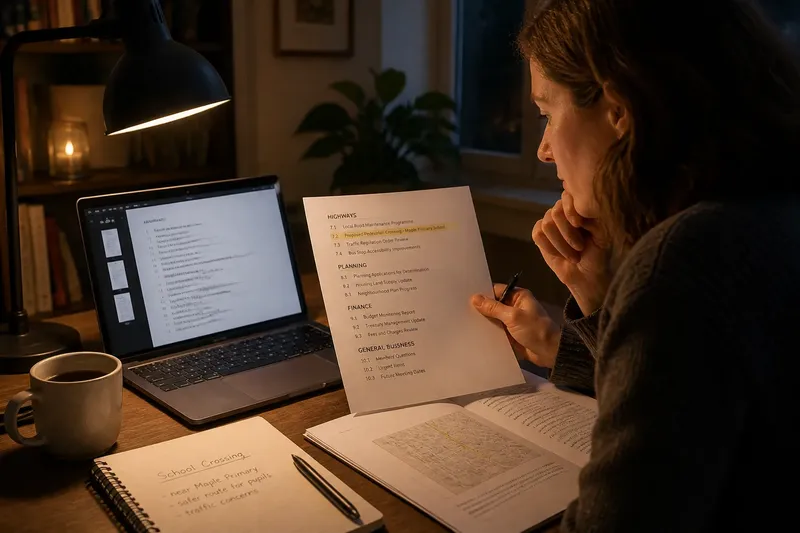
An agenda by topic helps you find business through its subject; an agenda by sequence helps you see where it sits in the meeting. Choose the route that matches your question, then use the item number to move between the agenda and its supporting paper.
Topic headings help when the concern has no formal title
A topic-based agenda groups business under headings such as transport, planning or finance. This is useful when you know the issue but not the wording officials used for it. A concern about a school crossing, for instance, may appear under “Highways” rather than “Road safety”.
Read the heading and each item title as a pair. The heading tells you the broad area; the title identifies the specific business. A broad category may also collect matters that are only loosely connected, so do not assume every item beneath it concerns the same project or decision.
If the expected item is not under the obvious heading, check neighbouring topics and any general business section. Councils choose their own filing labels, and a subject can fit more than one category. Treat the heading as a signpost, not a complete index of every term a reader might use.
Sequence shows the planned order, not an exact time
A sequence-based agenda lists items in the order planned for the meeting. Numbering makes it easier to refer to a particular entry and to see which business is scheduled before and after it. That is useful when you want to follow the meeting or understand an item’s position in the session.
The layout can be slower for subject searches. A report about a bus route may appear between unrelated items without a transport heading. Scan the titles from top to bottom, and use a PDF’s search or contents panel if available. Search for a distinctive place or project name as well as a broad subject.
The order is a plan, not a timetable. A meeting may pause or change its running order. If timing matters, check updates from the meeting organiser rather than estimating when an item will be heard from its number.
Match the agenda layout to the question you have
For a subject search, start with the topic headings and try alternate wording for the issue. For a question about position, find the title or item number and inspect the entries immediately before and after it. These are different tasks: one finds the business; the other places it in the meeting.
If the agenda is a scanned PDF, ordinary text search may not work. Use the page thumbnails or contents list to inspect the relevant section. Once you find an entry, note its item number and exact title before opening any linked report.
Say you are looking for a proposed crossing near a primary school, but the agenda has no “school crossing” heading. You search the PDF for the school’s name, find a numbered item under “Highways”, and record its exact title. You open the paper linked to that number, then return to the agenda and check the entries either side. The result is a clear route from the local concern to the scheduled business, without assuming the category explains the decision.
Check what the item asks the meeting to do
An agenda title can be brief. The linked report usually gives the substance: whether members are asked to decide, discuss, note information or consider a recommendation. Look for labels such as “for decision” or “for information”, then read the relevant section of the paper to understand the request.
Keep the agenda number beside the report title when switching documents. If the paper has appendices, check whether a map, schedule or other attachment is linked to the same item. This helps distinguish the report’s main request from supporting material.
Do not judge importance from placement alone. A matter in a late or miscellaneous section may still affect residents; the position can reflect the agenda’s format rather than the issue’s significance. Use the stated purpose and report content to understand the business.
Which agenda layout answers your question?
How can I tell if an agenda is grouped by topic?
Look for broad headings with several items beneath them, such as service areas or policy subjects. One continuous numbered list with no subject groupings is more likely to be arranged mainly by sequence.
What should I search for when an item title is unclear?
Try a place name, project name or service alongside the broad subject. If that fails, inspect nearby headings and general business sections, since the formal title may use different wording.
Does an agenda number tell me when an item will be heard?
No. It gives the planned position, not a reliable clock time. Check the organiser’s updates if the exact timing matters, because the running order can change.
What should I do if I cannot find the item?
Try alternate terms and check broad or miscellaneous sections before deciding it is absent. For a scanned document, use page thumbnails or its contents list if text search does not work.
Use this short check before you move on
- Check whether broad subject headings contain several items; if they do, search those headings first, then use the numbered list if you need the meeting order.
- Check whether the agenda uses one continuous numbered sequence; if it does, scan the titles or search a distinctive place name, then inspect nearby entries for context.
- Check whether the item title matches your concern; if it does not, try an alternate service, place or project term, then check adjacent headings before treating the item as missing.
- Check whether the PDF text search returns a likely result; if it does, confirm the title on the page, but if it does not, use thumbnails or the contents list.
- Check whether the item number matches the linked report; if it does, read the report’s stated request, but if it does not, return to the agenda and follow the correct number.
- Check whether the report lists attachments; if it does, open those relevant to the question, but if none are listed, rely on the report text rather than assuming a separate map or schedule exists.
For an agenda by topic or by sequence, the item number provides a reliable bridge between finding a subject and understanding its place in the planned meeting order. Note the exact title and number, then check the linked paper for what members are being asked to do.